
eSIM vs Roaming: Which Is Cheaper for International Travel?
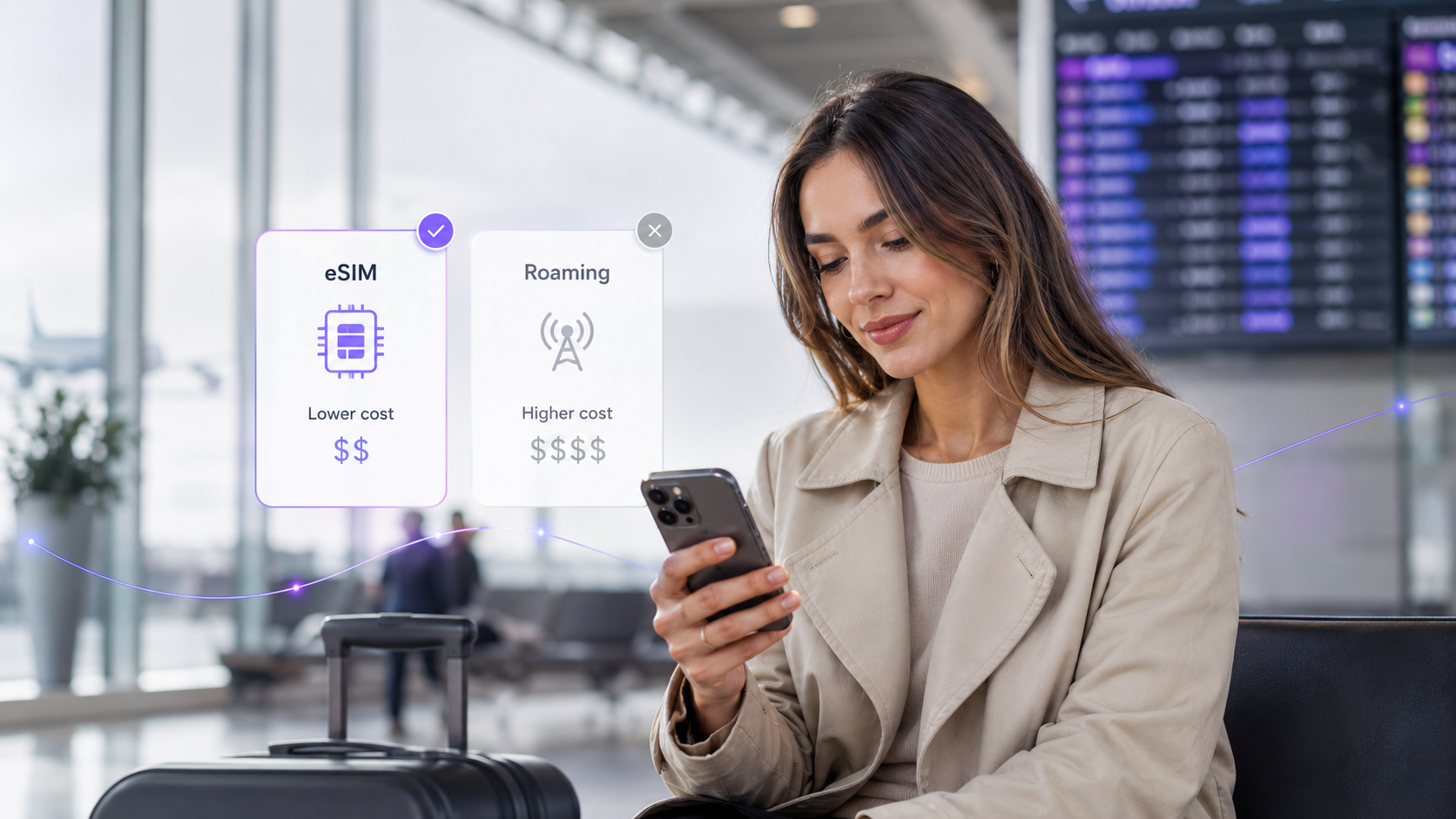
Traveler comparing eSIM and roaming costs for international travel on a smartphone
eSIM vs Roaming: Which Is Better for International Travel?
Planning an international trip and wondering whether to use a travel eSIM or your existing mobile provider's roaming service?
Both options can help you stay connected abroad, but they work differently when it comes to pricing, convenience, allowances and phone numbers.
International roaming lets you use your regular mobile subscription while traveling. A travel eSIM allows you to purchase a separate mobile data plan for supported destinations.
Choosing between eSIM vs roaming depends on where you're going, how much data you need and the benefits already included in your mobile contract.
This guide compares the options fairly, explains when each may be better and highlights important details involving Dual SIM phones, hotspot sharing and cruise ship roaming.
What Is International Roaming?
International roaming allows your mobile phone to connect to another operator's network while you're outside your home provider's network.
For example, a traveler from the United States visiting France may be able to access a French mobile network through their US provider's roaming agreement.
Depending on the subscription, roaming may include:
- Mobile data.
- Conventional phone calls.
- SMS messages.
- International travel passes.
- Daily or monthly roaming allowances.
Some subscriptions include certain destinations without additional charges.
Others apply usage-based fees or require a travel add-on.
It's important to check your provider's actual roaming conditions before departure.
What Is a Travel eSIM?
A travel eSIM is a digital mobile plan installed on a compatible phone.
Instead of physically replacing a SIM card, you download an eSIM profile and configure it for mobile data.
International travel eSIMs are commonly available as country-specific, regional or global packages.
For example, you might choose:
- A UK eSIM for a London holiday.
- A Europe regional eSIM for several European countries.
- An Oceania regional eSIM for Australia and New Zealand.
- A global eSIM for travel across continents.
Many travel eSIM plans are data-only, meaning they do not provide a conventional local phone number.
You can browse duasim eSIM plans to compare coverage and available allowances.
eSIM vs Roaming: Main Differences
Feature | Travel eSIM | Home-provider roaming |
|---|---|---|
Setup | Install a separate digital mobile plan | Often works through your existing SIM |
Phone number | Frequently data-only | Keeps your regular number |
Data allowance | Defined by selected eSIM package | Depends on your mobile contract |
Coverage | Specific destinations included in the package | Countries supported by your operator |
Payment | Often prepaid | Included allowance, pass or usage-based billing |
Calling and SMS | Depends on plan; many are data-only | Usually available according to roaming terms |
Hotspot | Depends on provider; duasim supports it | Depends on home plan |
Maritime service | Not generally included in ordinary travel eSIMs | May be available with separate charges |
Neither option is automatically superior.
The right choice depends on total cost and how you use your phone.
When Is a Travel eSIM Better?
A travel eSIM may be more convenient when your existing mobile plan has expensive international data roaming.
It may also be useful when you want to choose an allowance before departure.
For example, a traveler visiting Japan for two weeks may prefer a prepaid data plan instead of paying daily roaming charges.
Other situations where a travel eSIM is worth considering include:
- Multi-country holidays.
- Long international trips.
- Business travel outside your home provider's included destinations.
- Using mobile data without changing a physical SIM.
- Sharing a data connection with a laptop.
However, the selected package must include your destination and support your device.
When Is Roaming Better?
Your existing mobile contract may already include suitable roaming benefits.
For example, many eligible European customers can use their domestic allowances in participating European destinations under the Roam Like at Home framework.
In these situations, buying another data plan may provide little additional value.
Roaming may also be preferable if:
- Your employer provides a suitable international mobile package.
- You need conventional calls and SMS through your existing number.
- Your home provider offers an affordable travel pass.
- Your trip is short and the roaming allowance is adequate.
Always compare the full cost rather than assuming a travel eSIM is cheaper.
Can You Keep Your Number with a Travel eSIM?
Yes, on many compatible Dual SIM devices.
Your home SIM can remain active for calls and SMS while the travel eSIM provides mobile data.
This can help you maintain access to WhatsApp, account verification and business contacts.
However, keeping your number active may still result in home-provider charges for certain calls or messages.
The most important setting is selecting your travel eSIM as the mobile data line.
For instructions, read how to keep your main number active with a travel eSIM.
How Does eSIM Compare with EU Roaming?
The EU's Roam Like at Home framework allows eligible customers to use their domestic allowances in participating destinations, subject to fair-use rules.
Portugal, Spain, France and Italy are included.
The United Kingdom is outside the automatic framework, although some home providers voluntarily extend their roaming benefits there.
All duasim Europe regional eSIM packages include the UK.
That means travelers visiting London, Paris, Lisbon and other supported European destinations can consider a duasim regional plan even if their home provider has different UK roaming rules.
For multi-country travel, compare Europe eSIM plans.
Does a Travel eSIM Support Hotspot?
Some travel eSIMs support hotspot sharing, while others have provider-specific conditions.
duasim supports hotspot and tethering, allowing compatible smartphones to share mobile data with laptops, tablets and other devices.
All connected devices use the available eSIM data allowance.
This can be especially helpful for families and business travelers.
By comparison, hotspot availability under your regular roaming plan depends on your existing provider's terms.
Read our hotspot with a travel eSIM guide for setup instructions and data-saving tips.
eSIM vs Roaming on Cruise Ships
Cruise travel requires special consideration because ships may operate their own maritime mobile networks.
Traditional home-provider roaming can sometimes connect to these networks, potentially resulting in separate charges.
Ordinary country, regional and global travel eSIMs generally do not include open-ocean maritime service.
During supported port visits, a travel eSIM can provide mobile data through eligible land-based networks.
At sea, passengers may use the cruise line's Wi-Fi or an explicitly supported maritime service.
If you don't intend to use maritime cellular networks, airplane mode with Wi-Fi manually re-enabled can reduce the risk of unintended connections.
For detailed advice, read does an eSIM work on cruise ships?.
How to Choose Between eSIM and Roaming
Before departure, answer these questions:
- Which countries will I visit?
- Does my existing mobile plan cover them?
- What are the total roaming fees?
- How much data will I need?
- Do I need conventional calls and SMS?
- Will I use hotspot on my laptop?
- Does my phone support eSIM?
- Am I traveling on a cruise or through other special networks?
Comparing these details will usually make the decision clearer.
For data planning, read how much mobile data you need when traveling abroad.
How to Set Up a Travel eSIM Instead of Roaming
- Check that your phone supports eSIM and is unlocked.
- Choose a country, regional or global plan.
- Review coverage, data allowance and validity.
- Install the eSIM using reliable Wi-Fi.
- Select the travel eSIM for mobile data.
- Review the travel plan's roaming requirements.
- Disable data roaming on the home line if you want to prevent home-provider data charges.
- Test the connection after arriving.
If you experience connection issues, use our travel eSIM troubleshooting guide.
FAQ: eSIM vs Roaming
Is an eSIM cheaper than roaming?
It can be, particularly where home-provider roaming is expensive. However, pricing depends on the selected plans and destinations.
Does a travel eSIM eliminate roaming charges?
Not automatically. Your home SIM may still incur charges if used for calls, SMS or mobile data.
Can I keep my regular number with a travel eSIM?
Yes, on many compatible Dual SIM devices. Home-provider charges may still apply.
Does duasim support hotspot?
Yes. duasim supports hotspot and tethering using the available travel data allowance.
Can I use a travel eSIM on a cruise?
It can work in supported ports and coastal areas. Ordinary travel eSIMs shouldn't be assumed to provide maritime coverage.
Is roaming free in Europe?
Eligible subscribers may benefit from Roam Like at Home in participating countries, subject to fair-use rules. The UK is not automatically included.
Conclusion: eSIM vs Roaming — Which Should You Choose?
The choice between eSIM vs roaming depends on your existing mobile plan, destinations and communication needs.
If you already have sufficient roaming coverage, using your regular subscription may be convenient.
If you want a separate prepaid data option or your home roaming charges are high, a travel eSIM may be a practical alternative.
Review the complete terms before choosing, especially for calls, data switching and maritime networks.
Traveling internationally? Explore duasim eSIM plans and compare your options before departure.