
North America eSIM Guide: Data for USA, Canada and Mexico
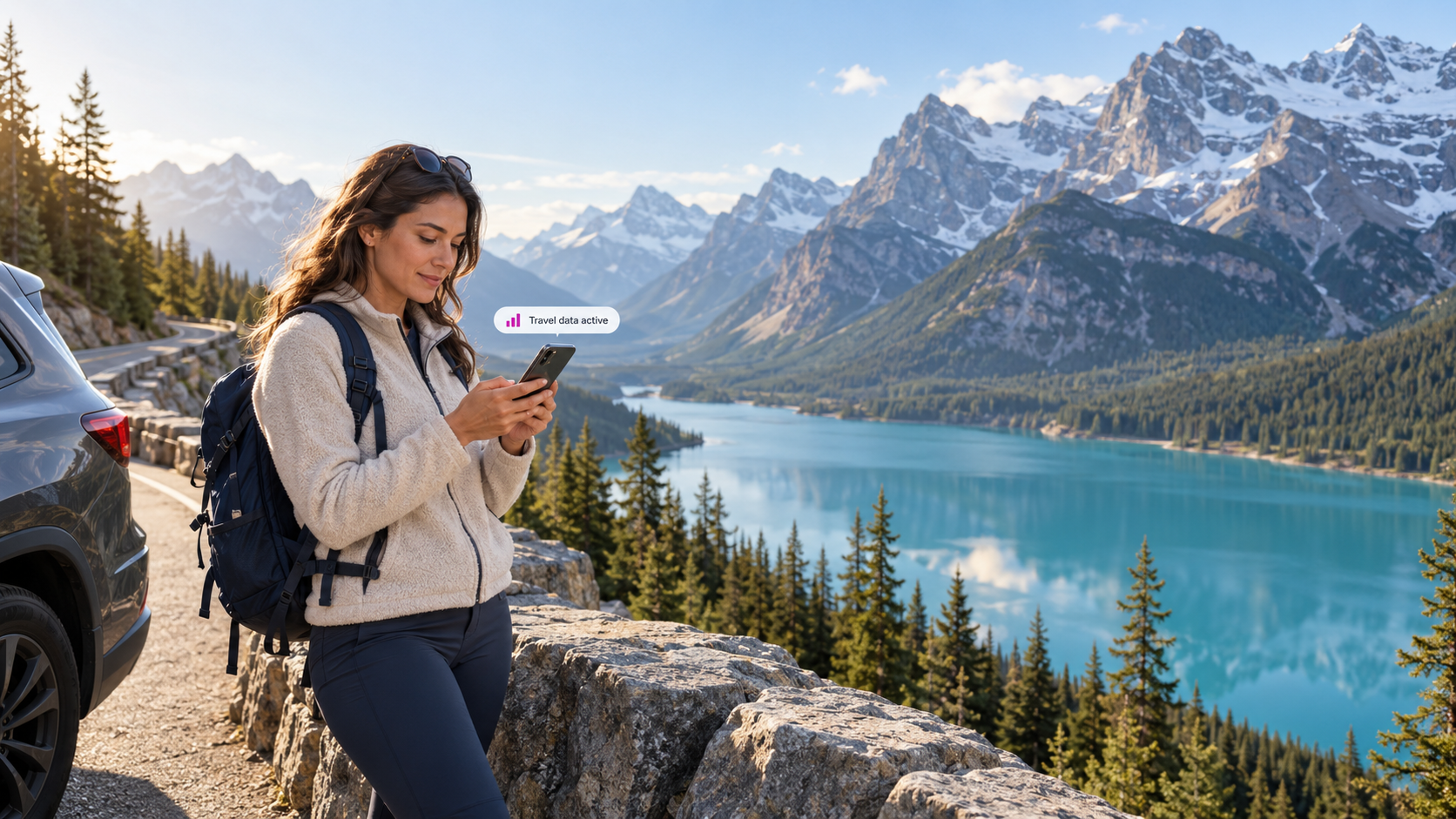
A traveler using a smartphone beside a turquoise lake in the Canadian Rockies, highlighting easy mobile connectivity with a duasim eSIM during a North America road trip.
North America eSIM Guide: Data for USA, Canada and Mexico
Planning a trip to North America? Whether you are exploring New York, discovering Toronto, driving through the Canadian Rockies, relaxing in Cancún or visiting several countries in one journey, mobile data can make your travels much easier.
North America is a popular destination for city breaks, business travel, road trips, national parks and beach holidays. Travelers often rely on their phones for airport transfers, maps, hotel bookings, restaurant reservations, transport apps, translation, messaging and travel updates.
A North America eSIM lets you buy a prepaid mobile data plan online and install it digitally without changing your physical SIM card. Depending on the selected plan, it may provide connectivity across the United States, Canada and Mexico, making it especially convenient for multi-country trips.
In this guide, you will learn how to choose a North America eSIM, when a country-specific plan makes more sense, what to expect from mobile coverage, and how to prepare your data before traveling.
If you are new to the technology, start with our guide explaining what a travel eSIM is and how it works.
What Is a North America eSIM?
A North America eSIM is a digital SIM plan designed to provide mobile data in selected North American countries. Instead of inserting a physical SIM card, you install the eSIM directly on a compatible smartphone.
Regional plans can be useful if your trip includes destinations in the USA, Canada and Mexico.
A travel eSIM can help you use mobile data for:
- Google Maps and Apple Maps
- Airport transfers and ride-hailing
- Hotel and accommodation bookings
- Public transport information
- Restaurant searches and reservations
- National park and road-trip planning
- Translation apps
- WhatsApp, iMessage, email and other internet-based messaging
- Online banking and travel apps
- Business and remote-work tools
Most travel eSIMs are data-only, meaning they do not necessarily include a local phone number or traditional calls and SMS.
With a duasim travel eSIM, you can prepare your mobile data before departure and manage your travel connectivity without replacing your physical SIM card.
Important: Regional packages do not always include the same countries. Before purchasing, confirm that your selected plan covers every destination on your itinerary.
North America eSIM vs Country-Specific eSIM: Which Should You Choose?
The best option depends on how many countries you are visiting.
Travel itinerary | Recommended option |
|---|---|
Only the United States | |
Only Canada | |
Only Mexico | |
USA and Canada | North America eSIM covering both |
USA and Mexico | North America eSIM covering both |
Canada, USA and Mexico | North America eSIM covering all three |
North America plus other continents |
A country-specific eSIM is often the simplest choice when you are visiting just one destination.
For more detailed destination advice, explore our USA eSIM guide, Canada eSIM guide and Mexico eSIM guide.
A regional eSIM becomes more attractive when you cross borders, particularly if you want to avoid purchasing separate data plans for each country.
Compare North America eSIM plans to find a package suitable for your route.
Using an eSIM in the United States
The United States offers everything from major cities and business districts to beaches, mountains, national parks and long-distance road trips.
Mobile data is useful when arriving at airports, booking transportation, navigating public transit or driving between destinations.
New York, Los Angeles and Major US Cities
In New York, mobile data helps with subway routes, ride-hailing, attraction tickets, restaurants and hotel directions.
In Los Angeles, it is especially useful for driving, traffic information, parking, sightseeing and transportation between neighborhoods.
Other popular destinations include Miami, Orlando, Las Vegas, San Francisco, Chicago and Washington, D.C.
A USA eSIM is also practical for business travelers who need access to email, calendars, navigation and cloud-based tools while moving between meetings.
US Road Trips and National Parks
If your trip includes California, Arizona, Utah, Nevada, Colorado or other regions known for road trips, mobile data can help with navigation, accommodation and travel planning.
However, cellular coverage can be limited in remote areas, including some national parks, deserts and mountain roads.
Before setting out, download offline maps and save important information.
If your trip is exclusively within the United States, compare USA eSIM plans.
For more detailed destination advice, read our USA eSIM guide for tourists and visitors.
Using an eSIM in Canada
Canada combines major cities, cultural attractions, scenic highways, national parks and some of North America's most spectacular landscapes.
Whether you are visiting Toronto, Vancouver, Montréal or the Canadian Rockies, mobile data is useful for airport transfers, public transport, maps, accommodation bookings and travel planning.
Toronto and Vancouver
Toronto is a popular destination for international tourists, business travelers and visitors exploring eastern Canada.
A Canada eSIM helps with public transport directions, hotel check-ins, restaurant bookings, attraction tickets and day trips to destinations such as Niagara Falls.
Vancouver offers a different experience, combining city travel with coastal scenery and outdoor adventures. Mobile data is useful for public transport, ferry information, local attractions and planning trips to Whistler or nearby destinations.
Montréal and Québec City
In Montréal and Québec City, mobile data is useful for navigation, restaurant searches, transport planning and translation.
Travelers exploring French-speaking areas may particularly appreciate having translation tools available throughout the day.
Banff, Jasper and the Canadian Rockies
The Canadian Rockies are among Canada's most popular road-trip destinations, with visitors exploring Banff, Lake Louise, Jasper and surrounding national parks.
However, mobile connectivity requires additional planning.
Coverage can be limited in mountain regions, rural roads and national parks. Parks Canada advises that travelers should not rely on cellular service along the Icefields Parkway between Lake Louise and Jasper.
Before heading into remote areas, download offline maps, save hotel addresses, check weather and road conditions, and keep important reservations available without internet.
A Canada eSIM is useful wherever its supported networks provide coverage, but it cannot guarantee connectivity in remote locations.
For more detailed travel advice, read our Canada eSIM guide for Toronto, Vancouver and the Rockies.
If your journey stays entirely within Canada, compare Canada eSIM plans before choosing a regional package.
Using an eSIM in Mexico
Mexico is a popular destination for beach holidays, cultural travel, food, historic cities, road trips and digital nomad stays.
Mobile data can be useful immediately after arrival, particularly when arranging airport transfers, checking hotel directions, using transportation apps or communicating with accommodation providers.
Cancún, Playa del Carmen and Tulum
Mexico's Caribbean coast attracts travelers looking for beaches, resorts, restaurants, archaeological sites and outdoor excursions.
A Mexico eSIM can help with airport pickups, accommodation details, restaurant bookings, navigation and planning activities around Cancún, Playa del Carmen, Tulum and nearby destinations.
In Cancún, mobile data is particularly useful when traveling between the airport, Hotel Zone and downtown areas.
In Playa del Carmen, it helps with ferry information for Cozumel, restaurant searches and local transportation.
In Tulum, travelers may need maps and booking details when moving between the town center, beach areas, cenotes and archaeological sites.
However, some remote beaches, jungle areas and excursions may have limited mobile coverage. Download offline maps and save important travel information before leaving populated areas.
Mexico City and Cultural Destinations
Mexico City offers museums, historic neighborhoods, restaurants, markets and major cultural attractions.
Mobile data is useful when navigating areas such as Roma Norte, Condesa, Polanco, Coyoacán and the Historic Center.
Travelers can use it for public transport planning, restaurant reservations, translation, ride-hailing and accessing attraction tickets.
Other popular destinations include Oaxaca, Guadalajara, Puerto Vallarta and Los Cabos.
Mexico Road Trips and Remote Areas
Mexico also offers road-trip opportunities through the Yucatán Peninsula, Baja California and other regions.
Mobile data helps with navigation, accommodation bookings, fuel stops and route planning.
However, coverage can vary outside major cities and tourist areas, particularly in rural regions, mountain landscapes and remote coastal locations.
Before longer drives, download offline maps, check road conditions and save important booking information.
For a complete destination-specific guide, including Cancún, Mexico City, Tulum, the Riviera Maya and road-trip connectivity, read our Mexico eSIM guide for Cancún, Mexico City and road trips.
If your trip is entirely within Mexico, compare Mexico eSIM plans before choosing a regional package.
Traveling Between Canada, the USA and Mexico
One of the biggest advantages of a North America regional eSIM is the possibility of using one data plan across several countries.
Popular travel combinations include:
- Vancouver and Seattle
- Toronto and New York
- Montréal and Boston
- California and Baja California
- USA and Mexico beach holidays
- Longer journeys through all three countries
If your selected regional plan includes each destination, you may be able to keep using the same eSIM after crossing a border.
For example, travelers combining Los Angeles and Baja California can review the USA eSIM guide alongside our Mexico eSIM guide before choosing between country-specific and regional plans.
Similarly, visitors combining Vancouver and Seattle can consult our Canada eSIM guide to understand connectivity considerations for Canadian cities and outdoor destinations.
When you enter another country, your phone may need a short period to register on an available local network.
If mobile data does not reconnect, try toggling airplane mode, checking which line is selected for mobile data, and following the provider's network and roaming instructions.
Remember: A North America eSIM does not automatically guarantee service in every North American country. Always review the specific package's destination list before departure.
Mobile Coverage in North America: Cities vs Remote Areas
Mobile coverage is an important consideration across North America because the region includes large cities, national parks, mountains, deserts and sparsely populated areas.
The experience can differ considerably by location.
In major cities such as New York, Toronto, Vancouver, Mexico City and Los Angeles, travelers can generally expect more extensive mobile infrastructure.
In remote areas, coverage can be limited or unavailable.
For example, Canada's telecommunications regulator identifies remaining gaps in rural and remote connectivity, while national park authorities warn about places without mobile coverage.
Similar planning is important for road trips through parts of the United States and Mexico.
To prepare for remote travel:
- Check the relevant mobile network coverage maps.
- Download maps and reservations.
- Save emergency contacts and accommodation details.
- Check weather and road conditions.
- Do not rely exclusively on mobile service for emergencies.
The best regional data plan is one that fits both your itinerary and the networks available where you intend to travel.
North America eSIM vs International Roaming
International roaming allows you to use your home mobile provider while abroad.
This can be convenient, but the cost depends on your provider, subscription and destinations.
Some mobile plans include Canada, the USA or Mexico. Others charge additional daily roaming fees or have different allowances for each country.
A prepaid North America eSIM may be useful if you want:
- A separate travel data allowance
- More predictable prepaid spending
- Mobile data without replacing your physical SIM
- One compatible regional plan for multiple countries
- Less dependence on public Wi-Fi
However, roaming may still be suitable if your existing subscription already includes sufficient data across your route.
Before deciding, compare plan prices, data allowances, country coverage and any applicable roaming charges.
For more information, read eSIM vs roaming for international travel.
North America eSIM vs Local SIM Card
Buying a local SIM card is another way to access mobile data abroad.
A local SIM may be useful for extended stays or travelers who need a local phone number.
However, purchasing a separate SIM in each country can be inconvenient during a multi-country itinerary.
You may need to visit a shop, complete registration, change SIM cards and repeat setup when crossing borders.
A regional eSIM removes the need to physically swap SIM cards and can simplify travel if all your destinations are included in the package.
For a more detailed comparison, read eSIM vs local SIM card.
How Much Data Do You Need for North America?
The right allowance depends on your travel duration and mobile usage.
Traveler type | Suggested data allowance |
|---|---|
Short city break | 1–3GB |
One-week holiday | 3–7GB |
Regular tourist | 5–15GB |
Multi-country traveler | 10–20GB+ |
Business traveler | 10–20GB+ |
Remote worker or heavy user | 20GB+ |
These are approximate planning ranges.
Maps, messaging and email typically use less data than video streaming, hotspot sharing, large downloads and video calls.
If you are traveling across several countries for multiple weeks, consider the total amount of data needed for the entire journey.
For additional guidance, read how much mobile data you need when traveling abroad.
How to Set Up a North America eSIM
Preparing your eSIM before departure is usually straightforward.
- Open the duasim eSIM store.
- Select the North America region.
- Confirm that the selected plan includes every country you intend to visit.
- Choose a suitable data allowance and validity period.
- Check your phone's compatibility.
- Complete your purchase.
- Install the eSIM using the provided instructions.
- Label it clearly, such as “North America Data.”
- When appropriate, select the travel eSIM as your mobile data line.
Install the eSIM using reliable Wi-Fi before traveling, but check when your package's validity begins and follow its activation instructions.
You can check your phone using the duasim compatibility checker.
For device-specific instructions, read how to install an eSIM on iPhone or how to activate an eSIM on Android.
You can also manage eSIMs in the duasim app.
Can You Keep Your Main Number Active?
Many eSIM-compatible smartphones support using two SIM lines.
This means you may be able to keep your regular SIM active for calls, SMS or verification codes while using your North America eSIM for mobile data.
A typical setup is:
- Main SIM: calls and SMS when needed
- Travel eSIM: mobile data
- Main SIM data roaming: disabled if you want to avoid unintended roaming data charges
- Travel eSIM roaming: configured according to the selected plan's instructions
Remember that your home provider may still charge for calls or SMS while abroad.
For more detailed instructions, read how to keep your main number active while using a travel eSIM.
FAQ: North America eSIM
What is a North America eSIM?
A North America eSIM is a digital SIM plan that provides mobile data in selected North American countries. It can be useful for travelers visiting the USA, Canada, Mexico or multiple destinations, depending on the package.
Does a North America eSIM work in the USA, Canada and Mexico?
Some regional packages include all three countries, while others may cover different combinations. Always confirm the selected plan's country list before purchasing.
Is a North America eSIM better than separate country eSIMs?
It can be more convenient if your itinerary includes multiple countries. For a trip focused on one destination, a country-specific eSIM may be sufficient.
Does a North America eSIM work in the Canadian Rockies?
It can provide connectivity where supported Canadian mobile networks are available. However, remote mountain roads and national parks may have limited or no coverage. Download offline maps before traveling.
For more advice, read our Canada eSIM guide for the Rockies and major cities.
Can I use a North America eSIM in Cancún and Mexico City?
Yes, if your selected regional package includes Mexico and the supported networks provide service in those locations.
For Mexico-specific coverage considerations, travel tips and data recommendations, read our Mexico eSIM guide.
Can I use a North America eSIM when crossing international borders?
Yes, if your selected plan includes the countries on both sides of the border. Your phone may need time to connect to a local network after crossing.
Does a North America eSIM include calls and SMS?
Many travel eSIM plans are data-only and do not include a local phone number. Check the plan details before purchasing if conventional calls or SMS are important.
How much data do I need for North America?
Light travelers may need 1–3GB, while regular tourists may need 5–15GB. Business travelers, remote workers and people visiting several countries may benefit from larger allowances.
Can I use a North America eSIM on iPhone and Android?
Yes, provided your phone supports eSIM and is carrier-unlocked. Check your specific model before purchasing.
Should I install my North America eSIM before departure?
Installing before departure is often convenient because you can use a reliable Wi-Fi connection. Follow the plan instructions to understand when activation and validity begin.
Conclusion: Choose the Right North America eSIM for Your Trip
A North America eSIM can simplify mobile data access when traveling through the USA, Canada and Mexico.
Whether you are exploring major cities, crossing borders, visiting beaches or planning road trips, having mobile data ready helps with maps, transportation, bookings, messages and everyday travel planning.
The best choice depends on your itinerary. Choose a country-specific eSIM for a single destination, a North America regional plan for compatible multi-country routes, or a global eSIM if your journey extends across several regions.
Before traveling, compare North America eSIM plans, check your phone with the duasim compatibility checker, and prepare your mobile data before departure.